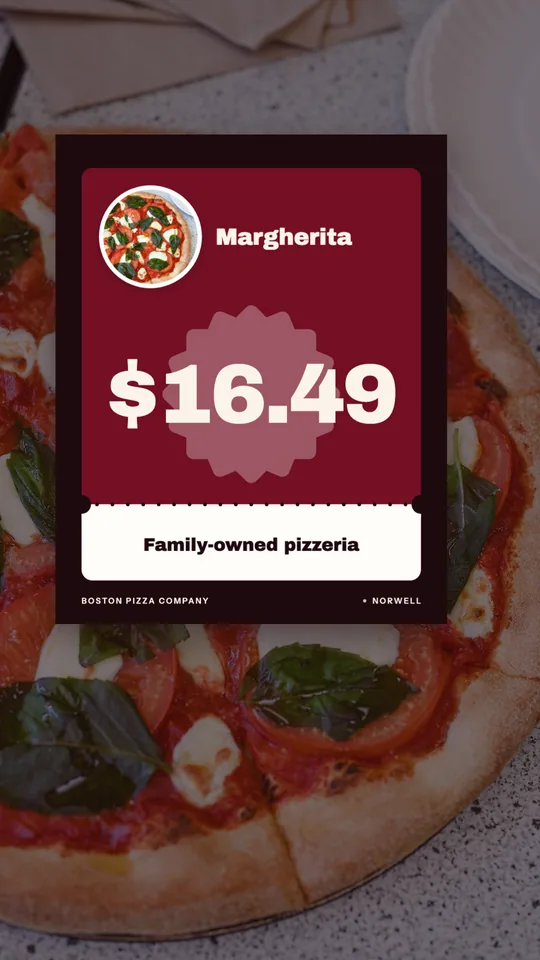
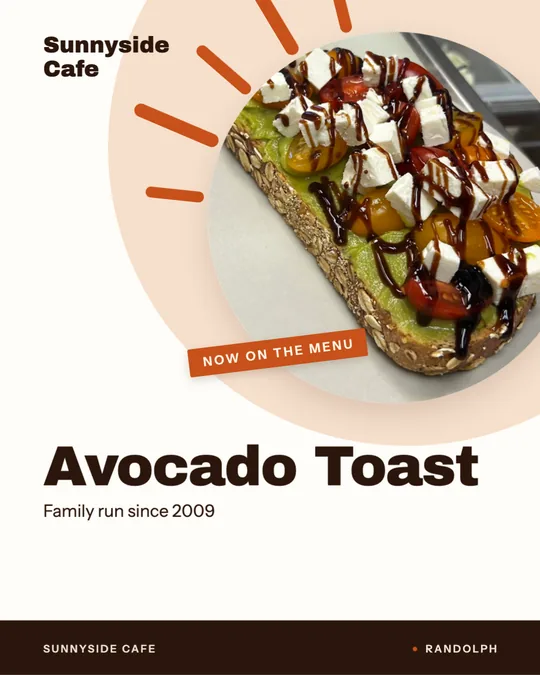
Every headline uses a fictional place, so swap in your own dish, price and neighborhood. Pick two or three patterns that match your slowest shift and ignore the rest.
How to use this list
Start with the problem, not the format. If Tuesday dinner is empty, choose patterns that push a weeknight offer. If nobody knows you exist, choose ones that introduce the dish and the place.
Each idea is a pattern: a repeatable structure you can fill with your own food. The headlines are examples of tone, not copy to paste. Check every claim, price and end date against what your kitchen can honor.
Photo ads: one dish, one reason
A still image has about a second to work. Give it one subject, one line and one action.
- The close-up: fill the frame with texture and say nothing clever. Headline: Crispy edges, soft middle. Juniper Street Kitchen, served until 10.
- The cutaway: show the inside of a layered dish. Headline: Six layers. Zero shortcuts.
- The hand shot: a hand holding the sandwich shows scale and makes it feel real. Headline: Bigger than your lunch break.
- The ingredient spread: raw components laid out beside the finished plate. Headline: What goes into the Harbor bowl.
- The price hero: the dish and the price, large, and nothing else. Headline: Two tacos and a drink for one price.
- The before and after: a sold out sign next to the restocked case. Headline: Back by popular demand, baked at 6 a.m.
Video ads: motion that sells appetite
Video earns attention with movement, so lead with the part of the dish that moves.
- The pull: cheese stretching, noodles lifting, yolk running. Headline: This is the pull you came for.
- The pour: sauce, syrup or a drink pouring in slow motion. Headline: Poured to order at Maple & Rye.
- The fire shot: flames, a hot pan, a wok toss. Headline: 600 degrees of dinner. Ready in 4 minutes.
- The prep time lapse: dough to oven in fifteen seconds. Headline: Dough made this morning, on your table tonight.
- The first bite: a real person reacts in one line. Use staff or consenting guests only. Headline: Our baker tries the new loaf.
- The countdown: a limited item with the days left on screen. Headline: Five days left for the peach tart.
Print ads and handouts: for the people who walk past
Print still works for a place people can walk to. Keep the layout simple, the type large and the next step obvious.
- The neighborhood flyer: a dish, an offer and a street name. Headline: New on Willow Avenue: wood-fired pizza.
- The bag stuffer: a small card in every takeout bag with a reorder offer. Headline: Order direct next time and the side is on us.
- The table tent: a specials card that sells while guests wait. Headline: Ask about tonight's short rib.
- The punch card: a simple loyalty prompt. Headline: Buy nine bowls, the tenth is yours.
- The local newspaper or community board ad: plain text, address, hours. Headline: Family dinners, Sundays at Corner Bao.
Out-of-home: billboards, signs and windows
Outdoor ads get a few seconds of a driver's or walker's attention, so the rule is seven words or fewer, one photo, large letters.
- The sidewalk sign: today's special in chalk or print. Headline: Soup and half sandwich, today only.
- The window poster: a big dish photo facing the street. Headline: Fresh pasta, rolled in this window.
- The directional sign: arrow and distance for a hard to find spot. Headline: Tacos, 200 feet. Turn left.
- The vehicle wrap: your delivery car as a moving ad. Headline: Hot and local. Call or order online.
- The transit or bus shelter poster: a single hero dish with a short URL. Headline: Dinner is two stops away.
Email and SMS: the cheapest ads you own
Messages go to people who already like you, so they can be direct. Always include a way to opt out, and send only to guests who agreed to hear from you.
- The win-back: a message to guests who have not ordered in a while. Subject: We saved your usual, Tuesday through Friday.
- The slow shift fill: a same day offer for a quiet hour. Text: Free dessert with dinner before 6 tonight. Show this text.
- The new dish alert: first look for subscribers. Subject: New this week: charred corn tacos.
- The loyalty nudge: a reminder of points earned. Text: You are one order from a free appetizer.
- The holiday cutoff: a deadline for catering or pickup orders. Subject: Order the holiday tray by Friday at noon.
Fast food ad patterns worth studying
Quick service advertising leans on a few ideas that any restaurant can adapt without copying any brand: speed you can prove, a value bundle with a simple number, a signature item shown as a character, and a limited run that creates urgency.
A local counter can use all four. Time the ticket honestly and say the number. Offer a combo with one price. Name your best seller and show it consistently. Run a seasonal item for a fixed period and end it on the date you promised.
What every strong food ad shares
Across all 27 ideas, a few traits repeat. The food is the largest thing on the page. There is one offer. The words are plain. The next step is stated, whether a phone number, an address or an ordering link.
Honesty matters as much as design. Photograph food that matches what you serve, state limits and dates, and never use a stock image of a dish you do not sell. A guest who feels misled by an ad rarely gives you a second chance.
Building these in Servestack Studio
Servestack Studio makes flyers, posters, dish photos, social posts, ads and reels from your name, logo, brand color and menu. Most of the patterns above map to something Studio produces: a price hero or combo creative, a poster with your exact words, a story or square for social, or a reel from clips of your own kitchen.
Pick two patterns, make a version of each, and compare results over a few weeks. Review each design for accuracy before it is printed or posted.
| Goal | Best format | Pattern to start with |
|---|---|---|
| Introduce a new place | Print and out-of-home | Neighborhood flyer or window poster |
| Fill a slow shift | SMS and email | Slow shift fill |
| Get first orders online | Photo and video | Price hero or first bite |
| Bring lapsed guests back | Email and SMS | Win-back message |
| Promote a seasonal item | Video and sidewalk sign | Countdown |